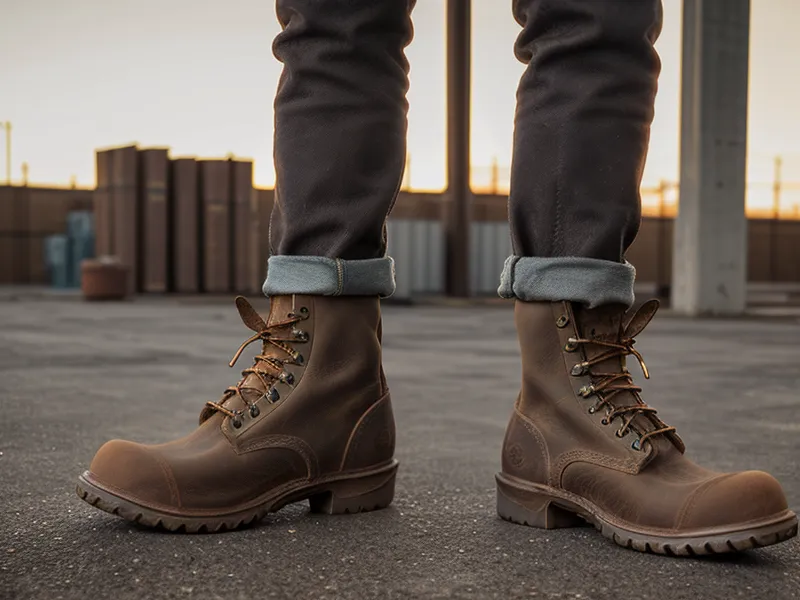
Three aisles into the perimeter check, it hits me that my heel hasn't rubbed once, not against the counter, not against the tongue, nothing. Twenty years in warehouse maintenance on concrete floors teaches you to notice a detail that small. This isn't the usual work boot review built around one testing sprint. It's a comparison between two approaches I've actually lived: cycling through disposable pairs versus committing to one built to be resoled, and what each choice costs you in footwear longevity over time. The Rocky Boots on my feet right now are the reason I finally have an answer.
Some of the links in this piece are affiliate links. If you buy through one, I make a small commission at no extra cost to you, which is basically what keeps me testing boots instead of just complaining about them on a lunch break.
The Bin Boots Had to Go
For years my answer was simple: grab whatever steel-toe pair sat in the Walmart bin, wear it into the ground, and grab another one every few months, writing it off as disposable gear. That's not a boot strategy. That's paying the same failure tax over and over, just in a different box. One of those bin pairs had an insole that went flat and dead before the four-month mark ever arrived, so every step after that landed straight on bare board. Another cracked clean across the toe box crease within weeks, right where the foot flexes with every step, because the synthetic upper had no give left in it once the cold set in. A third looked like it had real stitched construction sitting on the shelf, then started lifting right at the welt seam once road salt season hit, letting meltwater work into the gap before I noticed the sole shifting underfoot. None of that is a boot doing its job. I stopped treating boots as disposable the day I realized I was buying the same failure three times, just wearing a different label.
Thursday, Rocky, or Something in Between
Curt Walczak, one of the facilities techs on my crew, spent three weeks comparing spec sheets before he bought anything, then second-guessed the purchase the moment the box showed up. He'd been eyeing the Thursday boots, and so had I, but the toe box on that line runs tighter across the ball of the foot than a guy doing floor work wants, so I went with the wide-toe-box room the Rocky flagship line offers instead. What actually sold me was the Goodyear welt, and a field test like this one tracks whether that welt stitching starts wicking moisture before the leather even shows wear, which matters more long-term than how sharp the boot looks in the box. What it doesn't buy you is an easy first month. Break-in on a welted boot means the leather has to flex at the same three or four spots on your foot hundreds of times before it stops fighting back, and there's no shortcut through that stretch. I tried a hair dryer on the heels of an older pair once, years back, and came closer to scorching the finish than softening it. Patience and a couple pairs of thick wool socks do the job a blow dryer never will. Curt's pair loosened up the same slow, uneven way mine did, and only after real shifts on concrete, not a weekend spent breaking them in on the couch.
Georgia vs. Rocky on a Painted Concrete Floor
On a floor like this, polished concrete doesn't forgive anybody. It gives zero shock back, so a soft sole shreds under a loaded pallet jack and a hard sole leaves your knees ringing by hour seven, regardless of the name stitched on the tongue. I put Georgia Boots through the same floor for a stretch, and they're built heavier for exactly that kind of abuse, with a wedge sole that a lot of guys prefer over Rocky's lugged tread if they're planted at one station instead of walking a route all shift. Georgia wins if you're standing still at a press or a bench. Rocky wins if you're covering ground, because the lugged tread bites better on the turns around a pallet rack. Neither one changes the fact that concrete is what wears a boot down fastest, no matter which brand you bought it from.
The Heel Gave Out Before the Upper Did
DeShawn Quarles runs a forklift two rows over, and he's harder on a heel counter than anyone I've tracked in twenty years of watching boots come apart. I steered him into his first real safety boot after compliance flagged the sneakers he was wearing years back, figuring a name-brand heel cup would hold no matter how he landed on it. It didn't. Within a season the counter in that first pair had gone soft and folded in at the back, even though the leather everywhere else on the boot still looked new. We tried a stiffer aftermarket insert next, thinking the problem was underfoot, and that missed the mark too, because the collapse was happening above the sole, not below it. What actually worked was checking the heel cup by hand every few weeks instead of waiting for him to say something, and swapping boots out on that schedule instead of by how the tread looked. The upper matters too, and a full-grain leather upper on the Rocky boots I'm wearing now has held its shape better than the coated material his second pair came with, which speaks to upper material durability more than most spec sheets ever do. Arch support tells its own quieter story. It usually goes soft long before the outsole shows any wear at all, which matters if you're dealing with a foot condition, though that conversation belongs with a podiatrist, not a guy who fixes conveyor belts for a living.
Rocky Boots or a Bin Pair: Which One Earns Its Keep
Six months in, the real verdict isn't about Rocky beating everyone else on paper. It's about matching the boot to how hard you actually are on it. If you're rotating through work that might not last, or you're only on your feet four days a week instead of six, buying cheap and replacing it on a schedule isn't the dumbest move, as long as you actually swap it out before the insole gives rather than after. If you're clocking a full week on concrete or oil-slicked dock plates, that math flips. A welted boot like the Rocky Boots I'm still wearing costs more going in, somewhere around what you'd spend skipping a few fast-food runs over a month rather than any figure I'd bother quoting you, but it can be resoled instead of replaced, and that's the whole game.
Mine sits on a shelf in the garage now, lined up with the rest of the rotation under a fluorescent tube that's flickered for longer than I care to admit. I still catch that faint ammonia sting off the conditioner some evenings, working it into the welt seam and waiting for it to dry. Weekends, this same pair goes out to North Shore Trail with my mother's old Lab, dragging pond mud back through a house that used to smell like new leather more often than it should have. That's the actual test. Not whether a boot looks sharp in a photo, but whether you reach for it without thinking, six months and one more winter down the road.