A safety-toe boot either passes ASTM F2413-18 or it doesn't, and I got tired of pulling up three different vendor pages that all explain "EH rated" a little differently right when a new guy on my crew needs an answer in the next five minutes. So here's the page I actually send people to now: every rating code, every welt and stitch pattern, every sole compound I've had to explain more than twice at lunch, checked back against where the number actually comes from instead of whatever got printed on the box.
Safety Standards and Ratings
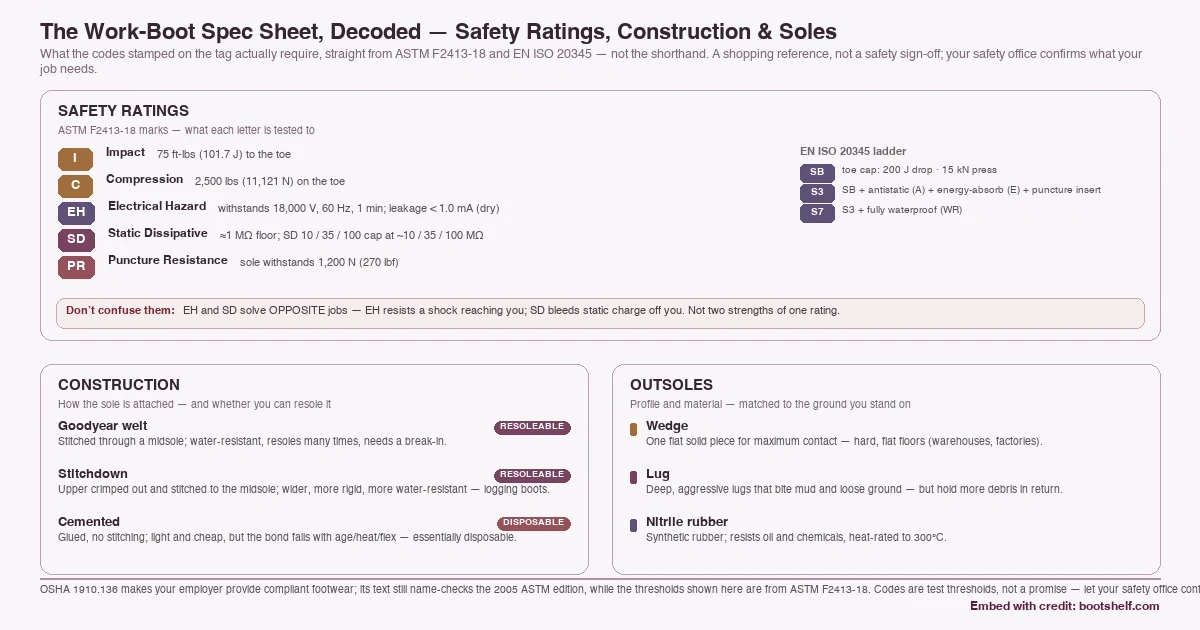
OSHA doesn't test boots itself. 1910.136 just tells your employer to buy footwear that meets a consensus standard, and funny enough, the regulation on the books still name-checks the 2005 edition of that ASTM spec, not the F2413-18 revision every boot on the shelf gets tested against today. Nobody's boots got less safe over that; the government's paperwork just never caught up. Here's what F2413-18 and the newer ISO codes actually require, not the shorthand printed on the tag.
| Rating Code | Standard | Requirement / Protection Level |
|---|---|---|
| I/75 & C/75 | ASTM F2413-18 | Impact (I) resistance tested to 75 foot-pounds (101.7J) and Compression (C) resistance tested to 2500 lbs. (11,121 N) (Thorogood). |
| EH | ASTM F2413-18 | Electrical Hazard: soles and heels must withstand 18,000 volts at 60 Hz for 1 minute, with current leakage under 1.0 milliamperes under dry conditions (Thorogood). |
| SD 10 / 35 / 100 | ASTM F2413-18 | Static Dissipative sub-classes share a resistance floor around 1 megohm; SD 10 tops out near 10 megohms, SD 35 near 35 megohms, and SD 100 near 100 megohms (TESTCOO). |
| PR | ASTM F2413-18 | Puncture Resistance: the sole must withstand a force load of 1200N (270 lbf) (Thorogood). |
| SB | ISO 20345:2022 | Safety Basic: toe cap drop-tested at 200 joules and compression-tested at 15 kilonewtons (uvex). |
| S3 | ISO 20345:2022 | Layers the additional protections most associated with this class on top of the SB toe-cap baseline: antistatic properties (A), energy absorption at the seat region (E), and non-metallic puncture-resistant inserts (P/PL/PS) (uvex). |
| S7 | ISO 20345:2022 | The former S3 class plus a fully waterproof whole-shoe rating (WR) — a waterproof S3 boot is labeled S7 under the current codes (uvex). |
Footwear Construction Methods
I had a pair of Brackenford boots come apart at the toe before the second salt season was even over. Cemented, not welted, though the tag never made that obvious at the store. Once road salt got into that bond line it started peeling, and I couldn't get much more wear out of them no matter what I tried. A welted boot from that same winter, on a coworker's feet, just needed a new sole instead of a trip to the dumpster. That's the whole argument for knowing which construction you're buying before you buy it, not after.
| Method | Process Description | Key Characteristics |
|---|---|---|
| Goodyear Welt | A strip of leather or plastic (the welt) is stitched to the upper and the insole; the outsole is then stitched to the welt. | Highly water-resistant; allows for multiple resoles; requires a "break-in" period (Red Wing Amsterdam). |
| Blake Stitch | The upper is folded under the insole and stitched directly to the outsole through the inside of the boot. | Greater flexibility and lighter weight; less water-resistant than a welt; requires a specific Blake machine for resoling. |
| Cement Construction | The upper and sole are bonded together using high-strength industrial adhesives without stitching. | Lightweight and cost-effective; the bond degrades with age, heat, and flexing, and once it fails there's no stitching left to hold the sole on (Ambrogio Shoes). |
| Direct Attachment (Injection) | The sole material (usually PU or TPU) is injected into a mold directly onto the lasted upper. | Creates a permanent, watertight bond; high shock absorption; cannot be resoled. |
| Stitchdown | The upper leather is flared outward and stitched directly to the midsole or outsole. | Common in heavy-duty logging boots; the extra stitching makes for a wider, more rigid base and better water resistance than a welt (Nicks Boots). |
Outsole Materials and Profiles
Outsole compound matters more than color or tread pattern once the shop floor turns into a griddle. I had a wedge sole hold up fine through a July heat wave that left the asphalt in the yard soft enough to leave a boot print, while a cheaper polyurethane midsole on another pair went soft and packed flatter every week until the heat wave finally broke. Paying up for the right compound the first time runs about what a couple of takeout dinners cost, and that's cheaper than replacing a pair before its time.
- Wedge Sole (Crepe)
- A flat-bottomed sole made from one solid piece of material, built for maximum contact on hard, flat surfaces like warehouse and factory floors (Thorogood).
- Lug Sole
- Features deep indentations (lugs) designed for traction on uneven, muddy, or rocky terrain. Deeper, more aggressively spaced lugs bite into mud and loose ground better than a shallow tread, though they hold more debris in return (Nicks Boots).
- Nitrile Rubber
- A synthetic rubber copolymer highly resistant to oil and chemicals, with heat resistance up to 300°C — enough to shrug off a hot patch of asphalt or a stray weld spatter that would eat a softer compound (Steel Blue).
- TPU (Thermoplastic Polyurethane)
- A plastic-based material that offers higher abrasion resistance and split resistance than standard PU, while remaining lighter than solid rubber.
- PU (Polyurethane)
- A lightweight, organic polymer used for midsoles and outsoles. It provides high shock absorption but can be subject to hydrolysis (deterioration) in high-humidity environments over long periods.
Last verified: 2026-07-17
Sources
- Thorogood: A Guide to ASTM Ratings and OSHA Work Boots
- TESTCOO: What Is ASTM-F2413-18? Protective Footwear Standard
- uvex safety: Guide to EN ISO 20345:2022
- OSHA Standard 1910.136 - Occupational Foot Protection
- Red Wing Amsterdam: Goodyear Welted Resoles
- Ambrogio Shoes Encyclopedia: Cemented Construction
- Nicks Boots: Goodyear Welt Vs Stitchdown Work Boots
- Thorogood: How to Choose Work Boot Outsoles for Your Job
- Nicks Boots: All About Lug Sole Boots
- Steel Blue: Outsoles Technology