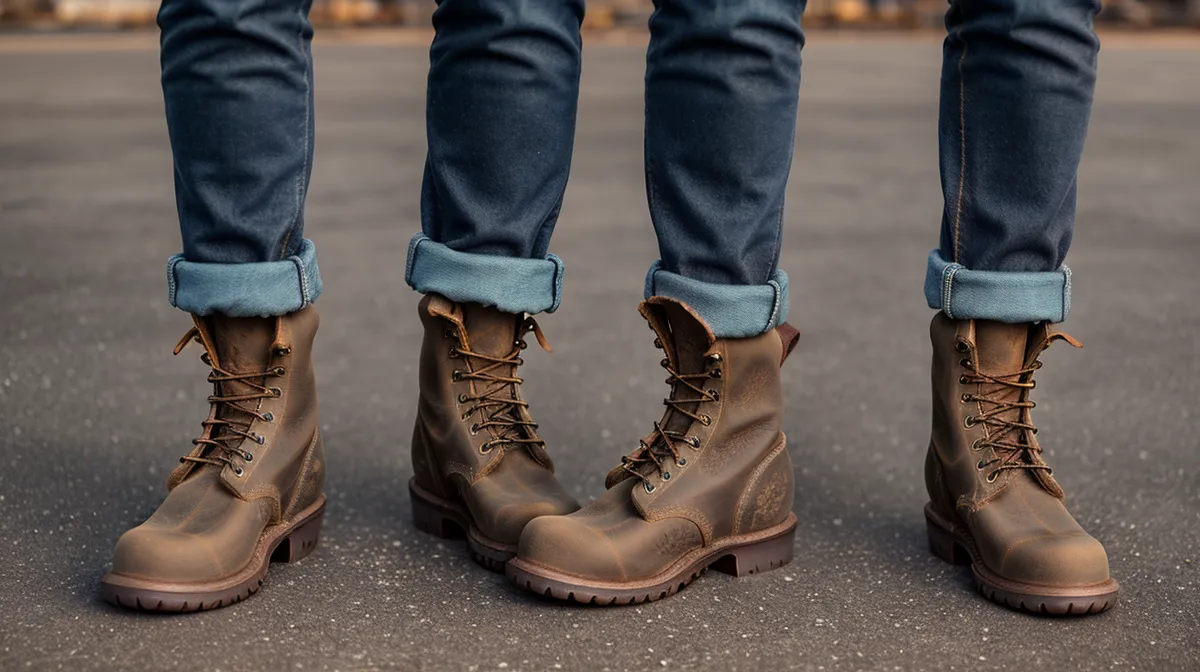
A boot that looks sharp enough for a walk around Settlers Ridge over in Robinson Township can still end up leaving a dull ache in your outer toe before the shift's even half over.
Short version, since I know most of you reading this are on a lunch break and not looking for a novel: the Thursday Boot Company Captains in my locker are a good-looking heritage boot with real construction underneath, and they still aren't enough boot for eight-plus hours on sealed concrete in a parts distribution center. That's the whole point of this work boot review — matching what a boot is actually built for against what a maintenance supervisor needs it to survive that long without complaint.
Short version on the money side too: clicking one of the Thursday Captains links on this page and buying through it sends a small finder's fee my way, at no extra cost to you. I paid for these with my own paycheck because I was done with the specials that fall apart before the first cold snap, and I'm not a podiatrist or a bootmaker — just a guy who logs a lot of steps on sealed concrete every day.
What a Maintenance Supervisor Actually Needs From a Heritage Boot
I'm a size 11 wide, and most of my life has been spent squeezing into boots built for feet with fewer opinions than mine. The Thursday Captain runs a 360-degree Goodyear welt, stacked over a three-layer setup with shock-absorbing EVA, a cork-bed middle, and a leather lining. On paper that's a serious spec sheet for a boot that also looks sharp enough for a Monday morning meeting.
Set next to a pair of Georgia Boots, which feel like they were cut from a truck tire, the Thursday leather feels thin, like it was built for someone who works in a loft, not someone who crawls under a conveyor belt for a living.
Does the Welt Construction Change Anything After a Year?
Here's the part that actually matters once the newness wears off: a Goodyear-welted boot like this one can go back to a cobbler for a fresh sole more than once, because the upper is stitched to a welt and channel instead of glued straight to the sole plate. A cemented boot, which is most of what fills the wall at a warehouse store, is held together by an adhesive bond, and that bond breaks down under water, oil, and heat. Once it lets go, there's no fixing it; you throw the whole boot out and buy another. That's the real argument for spending more on a heritage boot, and it has nothing to do with how the leather looks in the box.
None of that stops the leather itself from being thinner than what a dedicated industrial boot uses. During a hydraulic fluid spill near the loading docks one morning, I was glad I wasn't wearing these — my old Rocky Boots would have shrugged it off without a second thought. The leather grade on the Captain is also why the toe box stopped fighting me after a few shifts instead of a few weeks, a break-in curve I get into a lot more detail over in that field test.
The welt's stitching is its own separate topic — when the stitching, not just the sole, is what tells you it's time to retire a boot — and I lay that out in when to replace work boots after heavy wear.
I tried shortcutting the stiffness once, wearing a brand-new pair around the house for a week straight before my next shift, figuring I'd have them broken in before the floor ever saw them. That plan didn't survive contact with an actual shift. Carpet and a kitchen floor don't ask the same things of a boot that eight hours on sealed concrete does, and I still had a stiff heel counter and a hot spot on the ball of my foot by lunch anyway.
The Toe Box Still Runs Tight, Even in Wide
The tightness shows up in an odd spot: down on one knee restocking a low shelf, foot pivoted onto its outer edge, is when I actually feel whether a toe box has room to spare or not — and kneeling like that in the Captains, the box doesn't let go the way it should by now. Wide, on this last, mostly means normal width everywhere plus one extra measurement, not a cut built around a genuinely wide foot, and that's a fit conversation with a lot more nuance to it than one paragraph here can cover.
Weighing the Comfort System Against Concrete
Three layers of EVA, cork, and leather lining read great in a product description, and they're fine for a walk to the mailbox. Sealed concrete is a different animal than a showroom floor or an asphalt lot — there's zero give in it, and by the back half of a shift I could feel that cushioning bottoming out instead of bouncing back. Whether a midsole like this still has real support left in it well past the first year, or whether it packs flat the way a lot of arch cushioning does under all-day standing, is a longevity question of its own, and the Captain's version didn't hold its shape as long as I wanted.
Terri Pruszkowski runs second-shift dock supervision in the same building, and she logs more steps in a shift than anyone else on that floor. When she says a sole feels dead by the back half of a shift, I take it seriously, because she'd know before I would.
A reader named Gus Hornak — he wrenches on rigs pit-side out in western Ohio and burns through boots from the outside in thanks to all the oil and brake dust — asked me once whether a wedge sole would hold up better than a lug sole on his shop floor, and that's really a question for its own write-up, not a paragraph inside a heritage boot review that doesn't sell either option in a work-rated version.
The Captain's One Real Advantage
Credit where it's due: the look on these is a genuine advantage over anything built purely for a work site. I can wear the Captains into a Monday morning meeting and out for a Saturday walk without looking like I came straight off a shift, which is more than I can say for a steel-toe pair pulled out of a bin at the warehouse store. That crossover matters if your week actually splits between an office and the floor. It matters a lot less if you're on concrete for eight hours straight and need the sole still doing its job at the end of it.
The Final Call for the Shop Floor
Are they tough enough for maintenance work? Barely, and only for part of the job. If your day splits between an office and walking the floor to check on the crew, the Thursday Captains will do fine and look good doing it. If you're the one turning wrenches and putting up double-digit mileage on hard floors every shift, the thin leather and the softer outsole aren't going to hold up the way a dedicated work boot will.
Mine are staying in weekend rotation — a walk around Settlers Ridge with my mother's old Lab, or a dinner out where I don't want to look like I just clocked out. For the floor itself, I'm back in a pair of Rocky Boots or the heavier Georgia Boot line, and neither one is going to win a style contest sitting on a shelf.
Before you spend a half tank of gas worth of money on a new pair, figure out which floor you're actually going to be standing on, because that answer matters more than how the leather looks in the box. Outsole density beats a shiny upper every time you're on concrete past hour six. And if you want to see how a completely different kind of "fashion" boot handles grease and a distribution center floor, I put a pair of Dr. Martens through the same kind of shift work — the upper material holds up in its own way, and that comparison deserves its own read rather than a repeat here. Keep your feet under you out there.